The Making Computing Visible & Tangible (MCVT) project is exploring how a paper-based, physical computing kit can empower youths’ and educators’ learning and engagement with key computing concepts and practices.
Project Inspiration
Traditional approaches to teaching and learning about computer science continue to present barriers for participation, especially for youth and students from traditionally underrepresented backgrounds.
At BSCS Science Learning, we aim to design opportunities that break down these barriers.
To do so, we build on findings from physical computing materials to engage learners in making and programming personally relevant, hands-on projects. These types of constructive making activities expand the breadth and reach of computing by using familiar materials and appealing to new communities who share their interests, resources, practices, and knowledge with each other in social interactions.
We believe that young people need to be able to see and more deeply interrogate multiple systems–social, material, and computational–upon which powerful computational tools rely. This could enable learners to gain a greater sense of possibility, a sense that they can modify the tools and cultures of computing to better fit their own purposes, values, and identities.
To accomplish this, we purposefully make visible and modifiable selected components of normally opaque, or “black boxed”, computational technologies so that all learners can investigate, understand, and appreciate their parts, purposes, and complexities.
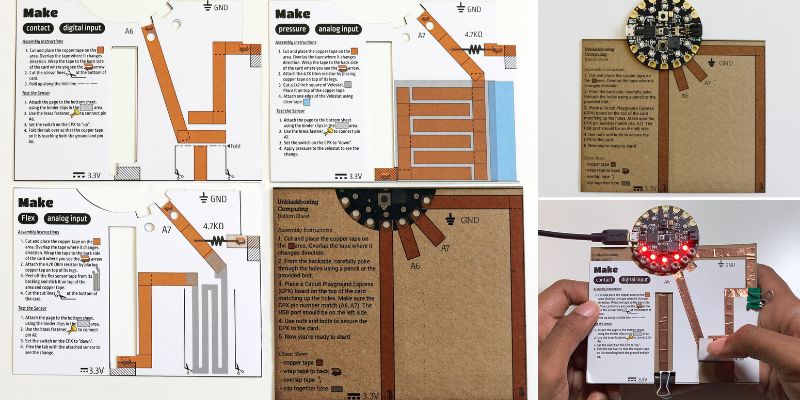
Figure: Early prototype of the MCVT cards
Photo Credit: HyunJoo Oh
About the Project
In this project, “making computing visible and tangible” refers to a design stance that values the beauty and transparency of seeing the inner workings of technical and computational systems, including electrical and mechanical systems. Designed in partnership with the CoDE Craft Group at Georgia Tech, the paper-based, physical computing kits scaffold youths and educators through using everyday materials to flexibly build onto different cards that involve key computational practices, such as inputs and outputs, logic statements, and sensing and actuating.
The kits “unblackbox” normally opaque computational processes, while enabling
- easy access and exploration through tinkering (in contrast to learning code syntax or programming languages) and
- interchangeability for educators and youths to use materials they have on hand to build onto the original kit design.
A key design feature of the MCVT kits is to enable space for personal stories and expertise through project design prompts that invite self-expression, such as “What lights you up?” and “Choose a place, a word, and/or an object that has meaning and importance to you.”
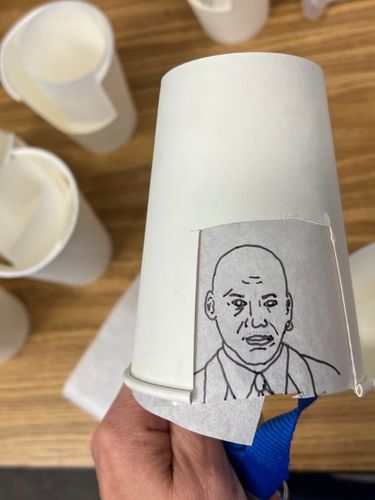
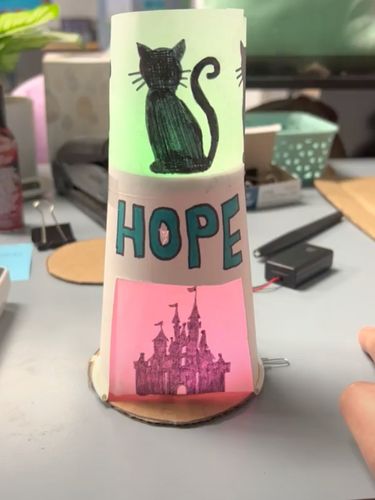
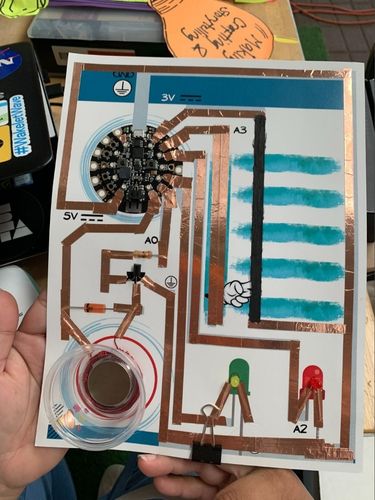
Figure: Projects created using MCVT cards by youth and educators
Photo Credit: Sherry Hsi & Sarah Jenkins
Over the past 2.5 years, the MCVT project has involved iterative co-design cycles of enactment by educators and youths from traditionally underrepresented backgrounds, positioning them as experts to provide feedback that then informed the redesign of the kit components. In collaborative design, participants, including young people, can gain direct experience in design practices, design critiques to shape technology futures, and experience connecting to the tools, materials, and representations of computing systems under development.
Along the way, we are documenting how interacting with the MCVT tools and culturally relevant design activities influences educators’ and youths’
- learning about computing concepts and practices,
- identification with and relationship to computer science as a discipline, and
- views on how to leverage those computational practices for their own pursuits and possible futures.
This research project has resulted in the MCVT kit of materials and parts to support inclusive computing education. The kit is now available, fully open-access.
What works best for teachers and students in science education interventions? Statistics can provide some insight—but only if interpreted in context. For instance, the way a study is conducted may impact the outcome, independent of the actual effectiveness of the intervention.
To help researchers understand study results in context, BSCS Science Learning reviewed hundreds of studies in science education while taking into account the various factors contributing to the outcomes. This work resulted in published findings for student outcomes (AERA Open Journal) and teacher outcomes (The Journal of Research on Educational Effectiveness) and online tools for researchers to use when planning or evaluating studies of science education interventions.
The online tools, POWER Calculator for Student Outcomes, and POWER Calculator for Teacher Outcomes use data from the studies BSCS reviewed to estimate the likely effect size for a new study based on its characteristics, such as the nature of the study, the scientific discipline, characteristics of teachers or students, and other key variables.
When planning a study, researchers can use the POWER calculators to determine how many participants will be required to obtain a statistically significant result, giving researchers and funders increased confidence that they will obtain such a result without spending money and time unnecessarily on participants that are not needed. Once a study is completed, the tool enables users to interpret the size of their study’s effect in the context of similar studies.
In addition to the research findings and POWER calculators, BSCS has published the two data sets related to student and teacher outcomes. Researchers who want to do their own meta-analyses of the studies can explore the data from different angles, while efficiently using BSCS’s coding system.
Results from these meta-analyses are published in AERA Open and the Journal of Research on Educational Effectiveness.
What exactly does a scientist do? How does she collect information and make sense of it all?
Data Nuggets are free classroom activities, co-designed by scientists and teachers, designed to bring contemporary research and authentic data into the classroom. Data Nuggets feature a scientist role model and the story of what inspired their research. In a Data Nugget activity, students are guided through the entire process of science, including identifying hypotheses and predictions, visualizing and interpreting data, supporting claims using data as evidence, and asking their own questions for future research. Because of their simplicity and flexibility, Data Nuggets can be used throughout the school year and across grades K-16, as students grow in their quantitative abilities and gain confidence. Data Nuggets have the potential to improve the understanding of science in society while engaging and motivating the next generation of scientists.
From topics such as “Won’t you be my urchin” to “Sticky situations: big and small animals with sticky feet,” teachers get to pick and choose from numerous options that get their students to think like a scientist, while the scientists who write the curriculum have an opportunity to share their research findings with a new audience in science.
Health-related information from family, friends, social media, and the internet bombard our lives every day. We make decisions as consumers about questions such as these:
- Why is caffeine powder dangerous when people consume caffeinated drinks every day?
- Why do people get a flu shot every year? Isn’t once enough?
- Who should take multivitamins daily?
- Why are some treatments used in other parts of the world not available in the United States?
Answers about health topics can be complicated. Understanding the science behind these questions requires the ability to ask questions and find and evaluate information from different sources.
BSCS Science Learning’s Developing Skills in Health Literacy project aimed to help middle and high school students develop critical thinking skills in topics about health that enabled them to accurately evaluate the information they got from various sources. This five-year project (2015-2020) worked with teachers from across the country to develop and study innovative instructional materials designed to enhance students’ skills and abilities in understanding human health.
In 2022, online curriculum modules for middle school and high school students were released and are freely available.
Middle school science teachers are always searching for professional learning (PL) opportunities and classroom curricula that are NGSS aligned. But time is limited, and high quality NGSS-aligned materials are scarce. That’s why BSCS Science Learning’s Three-Dimensional Teaching and Learning project (3-D Middle School Science), now known as A Medical Mystery, is valuable.
Since 2015, 3-D Middle School Science has been developing and testing digital curriculum materials and associated curriculum-based PL. For teachers, this project provides PL focused on how to implement (1) an NGSS-aligned unit and (2) high-leverage science teaching strategies through video-based lesson analysis. These STeLLA® strategies help teachers reveal, support, and challenge student thinking while maintaining a coherent science content storyline. In conjunction with the PL element, teachers are supported in an interactive online environment and through online synchronous discussions with a facilitator and colleagues.
Students in 3-D Middle School Science classrooms are immersed in an online environment that aids their understanding of complex concepts. A body systems unit challenges them to explore and ultimately solve a medical mystery: “What’s Wrong with M’Kenna?” Over the course of several lessons, students investigate how and why M’Kenna is constantly sick, unable to keep her food down, and losing weight. They use scientific reasoning skills and argumentation to identify the digestive system as the problematic organ system—and then engage with a series of interactive experiences, simulations, and animations to observe and analyze the differences between M’Kenna’s digestive system and a healthy person’s digestive system.
Ultimately, students solve the mystery and learn important lessons about how the features of specialized cells enable body systems to function, and they use that understanding to explain all of M’Kenna’s symptoms based on how body systems interact. More importantly, they learn to use the inquiry-based practices of scientists to construct their own understanding of complex phenomena.
A Medical Mystery is available in a free, stand-alone website.
Constructed-response assessments, in which students use their own language to demonstrate knowledge, are widely viewed as providing greater insight into student thinking than multiple-choice assessments. In the past, constructed-response assessments were expensive and time consuming to score. But recent advances in technology and measurement research are making them a feasible option for education settings. Lexical analysis and machine-learning technologies allow researchers to use computers to score student and teacher writing. The goal is to develop computer models that score written responses with the same levels of accuracy and reliability as human expert scorers.
BSCS Science Learning is leveraging these technologies in two research projects: PCK*lex and ArguLex.
The first project, PCKlex, explores measurement of teachers’ pedagogical content knowledge (PCK)—the type of teacher knowledge that bridges content knowledge and how to effectively teach the content in classrooms. It builds on several STeLLA® studies that have measured PCK as an outcome of professional learning, as well as on the work of the BSCS PCK Summit in 2012, which brought together researchers from around the world to develop a consensus model of PCK. The product of the PCKlex project will be a computer scoring instrument that measures teachers’ PCK. The instrument will analyze teachers’ written descriptions of instructional practices they are observing through a video analysis task. In this task, teachers are exposed to carefully selected video clips from science lessons in which content-specific pedagogical moves are strategically illustrated. The computer scoring instrument will accurately reflect the time-consuming process of human scoring and will be available online. It will provide rapid PCK scores for research and evaluation purposes as well as formative feedback for teacher educators, professional learning providers, and teachers themselves. This project is a collaboration with the AACR group at Michigan State University.
Following in the footsteps of PCK*lex is ArguLex, a project that applies similar technologies to the measurement of students’ abilities to engage in scientific argumentation. Explanation and argument are essential practices in the Next Generation Science Standards (NGSS). However, these new standards will only have a meaningful impact if they are accompanied by high quality assessments that are closely aligned with a three-dimensional vision for teaching and learning science. Such assessments require a shift away from reliance on the efficiency and affordability of multiple-choice items and towards the use of more subjective, written tasks, aligned to NGSS performance expectations. The goal of the ArguLex project is to use automated analysis and machine learning techniques to develop an efficient, valid, and reliable measure of students’ placement on a learning progression for argumentation. Additionally, we are interested in the degree to which the computer scoring models are more or less biased against English language learners than humans scoring the same data (relative linguistic bias) and the capacity for automated scoring to differentiate between linguistic fluency and argumentation ability.