Darwin Day 2026
February 12, 2026
Universities, hospitals, and industry must become willing to build their capacities in ways that complement capacities that have long existed within our tribal communities.
– Mallery Quetawki
Dear friends,
BSCS Science Learning has a long tradition of celebrating Charles Darwin’s birthday. In recent years, we’ve used this occasion to share stories of inspiring scientists from around the world who are making meaningful contributions to science today. This year, we are featuring an artist and scientist whose innovative work bridges Indigenous knowledge and Western science: Mallery Quetawki, a member of the Pueblo of Zuni in western New Mexico.
Mallery grew up surrounded by the rich artistic traditions of the Zuni community, including pottery, weaving, and handicraft making passed down through generations. She also witnessed health disparities in her community and a deep-seated fear of hospitals among tribal members. This concern sparked her interest in science and set her on an unexpected path.
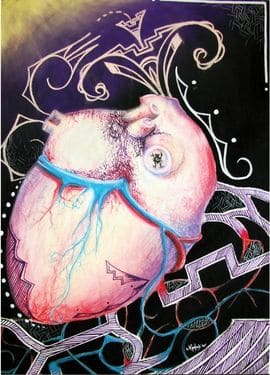
In 2007, after working as an intern at the Children’s Hospital Oakland Research Institute, Mallery created a series of chalk pastel drawings featuring the heart, brain, and other parts of human anatomy. When these drawings were later displayed at the Zuni Indian Health Services Hospital, something remarkable happened.
“The art created a wave of people asking about their personal health,” said Quetawki, who worked at the University of New Mexico Hospital in Albuquerque at the time. “I realized, ‘Holy smokes, this is an educational tool!'”
Today, Mallery holds a B.S. in biology with a minor in art studio from the University of New Mexico and serves as a Communication and Outreach Specialist and the Artist-in-Residence at the Community Environmental Health Program at UNM’s College of Pharmacy. She creates work that weaves traditional Zuni symbolism and other recognizably native designs with scientific concepts in ways that resonate both scientifically and spiritually with Native communities.

Her painting DNA Repair illustrates this beautifully. She compares the intricate process of DNA repair to the creation of beaded items in Native American culture, with a flower design symbolizing regrowth. Her influence extends far beyond her local community. Her artwork has been featured at the Metropolitan Museum of Modern Art and in a traveling exhibition called Exposure: Native Art and Political Ecology. The National Institutes of Health has featured her work, and she has received grants to train more artists and storytellers to share health information with Indigenous communities.
“Universities, hospitals, and industry must become willing to build their capacities in ways that complement capacities that have long existed within our tribal communities,” she emphasizes.
We’ve been fortunate to feature Mallery’s work at BSCS. When developing a unit for the OpenSciEd elementary school science program, we sought out notable examples of scientific communication and found Mallery. We featured her in Meet the Expert: Mallery Quetawki, a book that shows how she creates paintings and drawings to communicate scientific ideas. Students read the book during a unit in which their task is to communicate ways that people can protect plants and animals in their community.
On this Darwin Day, we celebrate Mallery Quetawki, an artist, scientist, educator, and bridge-builder who demonstrates that diverse ways of knowing can work together to create more effective, inclusive, and culturally responsive science communication. Her work reminds us that scientific understanding is enriched when we include other perspectives and knowledge systems.
Sincerely,

Daniel C. Edelson
Executive Director
References:
[1] “About the Artist: Mallery Quetawki,” Diabetes Care, vol. 46, no. 12, December 2023.
[2] “Mallery Quetawki – Using Art to Improve Environmental Health Literacy Among Indigenous Tribes,” National Institute of Environmental Health Sciences.
[3] “Mallery Quetawki,” Institute of American Indian Arts, September 2021.
[4] “Features,” SRP Science Digest, December 2020, National Institute of Environmental Health Sciences.
[5] “Mallery Quetawki: Circulatory Systems + Translational Aesthetics,” Southwest Contemporary, September 2024.
[6] “Mallery Quetawki,” Western Exhibitions of American Indian Art.
Artwork in sidebar: DNA-All My Relations by Mallery Quetawki
