Join Us in Empowering Teachers to Spark Curiosity in Every Learner
November 25, 2025
It’s not uncommon for me to only have five girls in a class of 20 students. When they start the unit in fourth grade, they keep to themselves because they’re in the minority. But as we get outside and start sharing observations and making connections, I see things start to shift.
– Lucia Brea
Dear friends,
Lucia Brea, an elementary school teacher in New York, believes every child deserves access to amazing science. This includes kids who are learning English as a new language. And it includes girls who have been conditioned to avoid STEM. Lucia understands both of these experiences on a deeply personal level, as she moved from the Dominican Republic to the United States when she was nine years old.
Today, she strives to be the teacher she once needed. That’s why she’s using Why is the Land Changing? a customizable earth science unit from BSCS. Developed as part of a research project on place-based learning, this unit encourages teachers to incorporate local phenomena into their lessons and provides them with guidance on how to do that.
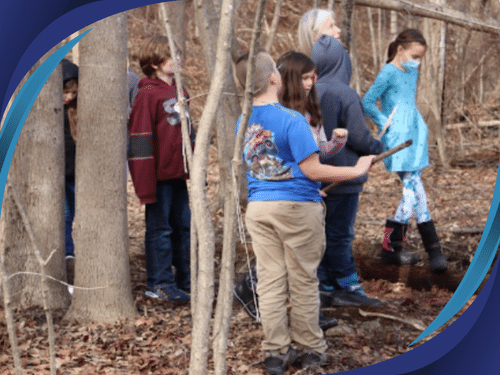
Lucia’s elementary students come from many different countries. They are native Spanish, French, Portuguese, and even Indigenous language speakers who still struggle to communicate in English. She’s noticed how much they open up and connect through outdoor experiences. That’s why Lucia wanted to try the unit. It begins with a simple question: What’s your favorite outside place? As she’d hoped, this question engages her students and allows her to learn more about them. It also provides an entry point to the exploration of weathering and erosion.
“Last year, a student mentioned a park I’d never heard of. He kept talking about big rocks. So, we took a walking trip and noticed things along the way,” Lucia says. Students looked at a huge hole in a basketball court and wondered how it got there. Then at the park, the students found the “big rocks” and speculated about how they got there. Lucia reports that their conversations were amazing.
As Lucia guided her students through the unit, which focuses on a rockfall in Yosemite Valley and a flash flood in Glen Canyon, Utah, students were able to make connections to the holes and the boulders they’d seen on their field trip. Lucia explains, “Yosemite is far away from New York. So, at face value, it’s not relevant to my students, but because this unit gives us the freedom to integrate local phenomena and places, my students get to discover their own way to make the science surrounding Yosemite relevant and interesting to them. It’s really cool to see.”
The design of the unit combines the power of direct, personal experience with the excitement of remarkable, extraordinary phenomena that they may never personally experience. Previously, students might not have seen anything interesting about the boulders in the park, but customizing curriculum to connect to the local context enables students to see that puzzling, natural phenomena are all around them. While Yosemite is remarkable and remote, Lucia’s students have the opportunity to see that the same geologic processes are happening in their community.
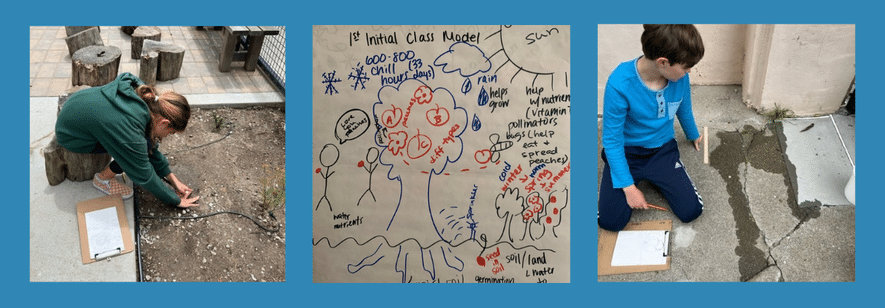
For some students, these connections are profound. One of Lucia’s students remembers how his house fell apart in a flood when he lived in Guatemala. He’s starting to understand how that happened as he constructs a scientific explanation of the changes brought about by the Glen Canyon flood.
Girls are engaging in new ways, too. “It’s not uncommon for me to only have five girls in a class of 20 students. When they start the unit in fourth grade, they keep to themselves because they’re in the minority. But as we get outside and start sharing observations and making connections, I see things start to shift.”
Take Natalia, for instance. When the class walked to the park for the first time, Natalia noticed all the holes in the ground. That’s probably because she was always looking down. Fast forward to fifth grade, when the class combines science with a civics project. The students create and study a pollinator garden and then share their findings at the Green Fair. All the girls are actively participating in this work, and Natalia is confidently leading the charge.
“It’s really fun to see this shift between fourth and fifth grade. The big switch occurs because everyone is given space to share what they notice and think. Everyone is on a level playing field, which isn’t the experience most girls have outside of school. Now they’re saying, ‘I can totally see myself doing this’ or ‘I didn’t know I liked science, but I do.’”
Lucia has been reflecting on her own childhood experiences lately. Her brother is an engineer. She recently told him, “If I had felt more empowered growing up, maybe I would be an engineer too.” However, her impact is evident in the classroom. Her students have a teacher who is inspiring the next generation of scientists, engineers, innovators, and lifelong learners. At BSCS, we are excited to play a role in her story and in the stories of her students.
Your support makes this work possible. By investing in BSCS, you are helping us equip teachers like Lucia with the tools to reach every student. You are ensuring that all students have the opportunity to see themselves as scientists.
With gratitude,

Daniel C. Edelson
BSCS Executive Director
BSCS developed the unit, Why is the Land Changing? as part of a collaborative project with the Maine Mathematics Science Alliance. Learn more about the work.
This work was funded in part by the National Science Foundation, grant #2009613. Any opinions, findings and conclusions or recommendations expressed in these materials are those of the author(s) and do not necessarily reflect the views of the Foundation.