Why Science Leadership Matters: A Sit-Down with PDPI Leader, Jody Bintz
March 30, 2026
Ahead of the September 2026 Professional Development Provider Institute, we spoke with Institute leader Jody Bintz about the impact of high-quality leadership development. In our conversation, Jody highlights how the institute helps leaders move beyond being “experts with every answer” to becoming facilitators who empower teachers and students alike. Read the full Q&A to see how your district can join this community of science education leaders.
For those not familiar with our Professional Development Provider Institute, what is the purpose behind the program?
Who supports the people doing the supporting? Most professional learning leaders spend all their time supporting others, leaving very little room for their own growth. Our PDPI changes that. It is a space designed specifically for leaders to strengthen their leadership capacity and practice alongside colleagues who share a vision and face the same challenges.
The PDPI has always been rooted in next-generation science, but we have shifted our focus toward curriculum-based professional learning, helping leaders get the best possible instructional materials for their local context into the hands of teachers prepared to use them. In this way, we turn the vision of NRC’s Framework into a reality for teachers and students alike.
You often share how much you love working with education leaders as ‘change agents’ in their school or district. How does that connection inspire your leadership of these Institutes?
Connecting with these change agents inspires me because I see so much potential for systemic change and individual growth. My leadership is grounded in the perspective of someone who has been in their shoes. I began my career as a high school science teacher and teacher leader before moving into a regional science and school improvement role. My experience drives me to ensure our Institutes offer leaders the needed space to learn. That includes opportunities to be reflective, hear other’s perspectives, or consider new approaches to designing and leading professional learning.
What is the most common ‘aha moment’ you see from veteran science professional learning leaders during these four days?
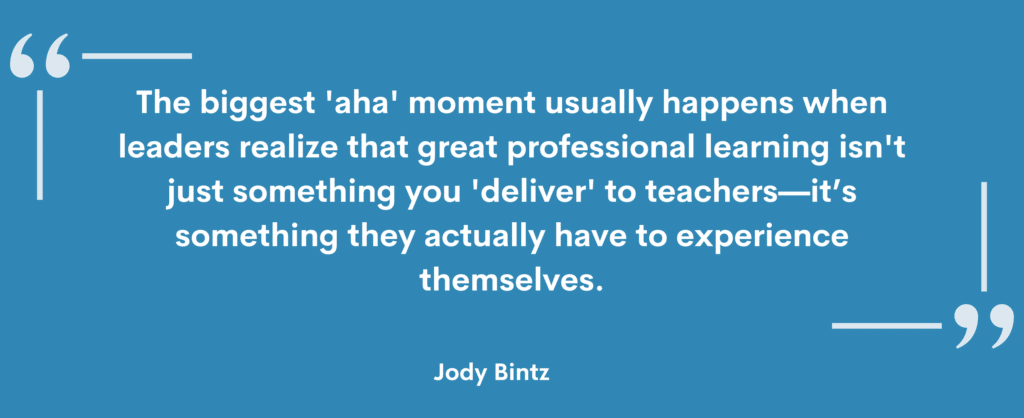
The biggest ‘aha’ moment usually happens when leaders realize that great professional learning isn’t just something you ‘deliver’ to teachers—it’s something they actually have to experience themselves.
We teach them a design process where the instruction itself mirrors exactly what we want to see happening in a science classroom. It’s all about creating a space where everyone—whether it’s the students, the teachers, or the district leaders—can make their thinking visible. They get to really grapple with tough concepts and come out the other side with a much deeper understanding. It’s less about being talked “at” and more about doing the work together.
But I should note that the most critical shift is not about a single ‘aha’ moment, but rather about learning over time.
Many of us begin our PL leader career thinking about individual workshops and what it means to plan and lead a discrete event. That makes sense because that’s what we experienced during our own teaching careers.
Through the PDPI, PL leaders learn to design and lead full programs that promote coherent, transformative learning that sticks. It’s a bigger lift, and honestly, it requires a mix of advocacy, creativity, and quality. You have to advocate for the time and funding science needs; you have to be creative to meet your goals within those constraints; and the quality has to be so high that teachers are not only showing up, but they’re actually coming back and asking for more.
What is the ‘secret sauce’ for building a support system that ensures long-term impact?
I think the ‘secret sauce’ is really about partnership. The best possible support system for teachers has to integrate external, research-based expertise with the deep, contextual knowledge that only local district leaders possess.
Too often, when a district adopts a new science program, they fall into the trap of treating professional learning like a one-time ‘product orientation’—just a technical walkthrough of the curriculum. While that kind of quick, pragmatic training feels helpful in the short term, it usually only touches the surface.
Our approach goes much deeper. We focus on building what I call ‘implementation muscle.’ We want to ensure districts aren’t just launching a curriculum, but sustaining it. Real transformation happens when we move past basic ‘training’ and invest in authentic, curriculum-based learning. We offer educators the structured time they need to actually experience the materials as science learners themselves. That’s how they build the confidence to keep growing as they implement.
Leaders play a critical role in ensuring all parts of the system are aligned to support teachers in making the shifts in their practice called for by the NGSS and HQIM. At one end of the spectrum district leaders ensure that the expectations set-forth in evaluation systems are consistent with student-centered science teaching and learning. At the other end of the spectrum district leaders ensure that teachers have the resources they need for the day-to-day lift with their students.
Ultimately, when science feels like a list of disconnected facts, students disengage. But when instructional practices shift from ‘learning about’ a topic to ‘figuring out’ a phenomenon, everything changes. Leaders who know how to support this shift are able to exemplify the vision and develop the culture that allows teachers to connect learning and engage students. That is the investment that truly moves the needle.
At BSCS we often consider the impact we have made in science education. What kind of impact has the PDPI had on schools and districts?
Since we launched in 2013, the PDPI has really grown nationally. We’ve hosted 23 individual Institutes and worked with over 400 science education leaders from New York to Hawaii and various districts in between.
The feedback has been incredibly validating. I remember one particular cohort of teachers; they didn’t initially see themselves as leaders, yet 95% of them recommended the experience to others. But beyond the numbers, what I’m most proud of is that our participants share that they leave the Institute with learned skills and strategies that are applicable and doable in practice.
And because we specialize in long-term capacity building, much of our impact is also measured in our rich district partnerships. For example, we’ve had a decade-long relationship with a mid-sized district serving about 40,000 students in the southeast. They started small, piloting a single team with us. But once they saw how we could help them design professional learning that was coherent and transformative, they scaled up. We eventually became their primary partner in laying the foundation for selecting and implementing high-quality instructional materials.
We also work closely with large urban districts. One major district in the Midwest, for example, joined us in 2013 with just their science directors. Over time, they brought their entire leadership team into the fold. Our partnership continues today where our joint efforts are now focused on the ‘last mile’—customizing high-quality materials to fit their specific state standards and local context.
We also partner with regional and educational non-profit organizations to scale our reach. We recently spent three years working with 60 leaders across eight different districts hosted by the Monterey Bay Aquarium. It was powerful to see these participants gain the skills, confidence and enthusiasm to continue to advocate for science education in their district.
Who is the audience for these Institutes?
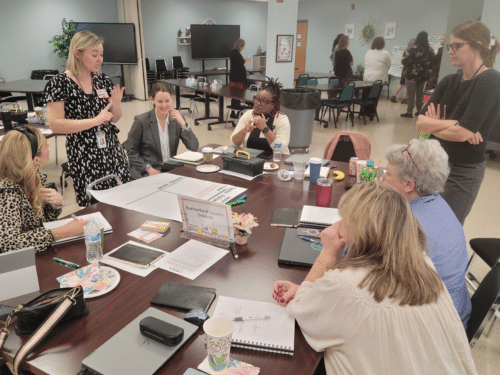
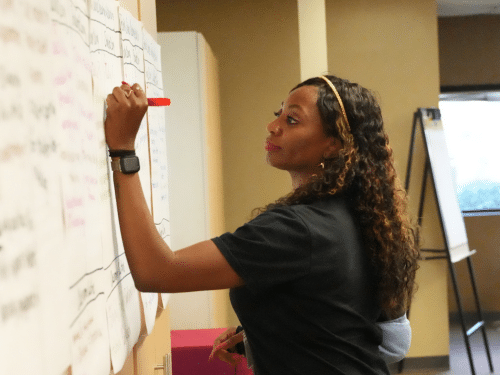
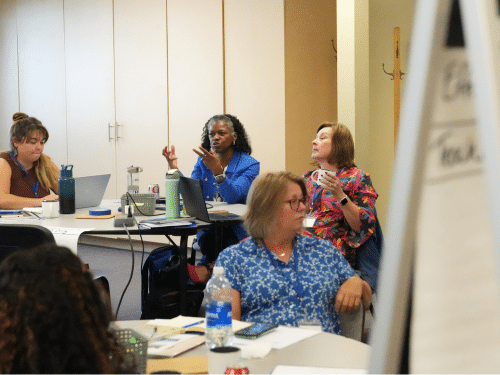
These Institutes are designed for anyone who wants to lean in and strengthen their leadership practice. We’ve really designed them to be inclusive of the entire ecosystem of science education leaders from teachers to district, regional, or state staff, to university faculty.
We’ve had Institutes that included teachers stepping into new leadership roles for the first time who were sitting with veteran leaders looking for better ways to build and support their teams. We also work with university faculty who are preparing the next generation of teachers.
How does BSCS support participants after they leave Colorado? Is there a community of practice or follow-up coaching available?
The Institute is the beginning of a relationship, not a one-off event. Beyond the sessions, we provide leaders with access to our team and resources. Moreover, we foster a network of peers across the country. For districts looking for deeper transformation, we often discuss hiring BSCS for custom, long-term support. These services include coaching, professional learning programs, and consulting.
Looking ahead, what’s next for PDPI?
The next Institute is all about three-dimensional, phenomenon-based teaching and learning with a focus on analyzing and interpreting data, constructing explanations, and engaging in argument from evidence. We will be thinking together about leading change over time and building implementation muscle!
Registration is open to everyone. While this is the second Institute in the series, participation in the first Institute is not required.
What’s on the horizon at BSCS?
Our team will be headed to Texas soon! We’ll be leading a series of Institutes both in-district and across the state. We’d love to chat with other leaders who are interested in building strong science programs in their district. Drop us a line–let’s make it happen.
About Jody Bintz
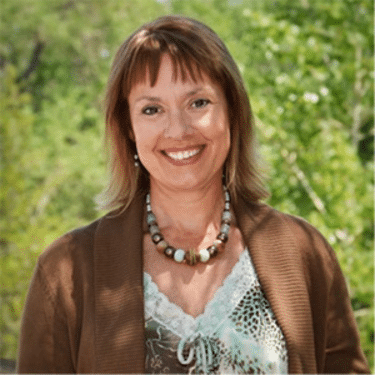
Jody Bintz, MA, Director, Strategic Partnerships and Leadership & Capacity-Building at BSCS Science Learning, has dedicated over two decades to improving science teaching and learning through leadership development and teacher professional learning.
Before joining BSCS, Jody served as an instructional services consultant in a regional service agency in Iowa, focusing on school improvement and science. Today, she leads national efforts to implement the Next Generation Science Standards (NGSS) by fostering communities of practice with district, regional, and state leaders Her research-driven approach has directly impacted leader practice, teacher practice, and student achievement in diverse districts, from urban centers to rural communities across the country. Jody earned her Bachelor of Arts degree in Biology from the University of Northern Iowa and her Master of Arts degree in Science Education from University of Northern Iowa. Read more about Jody and her work.