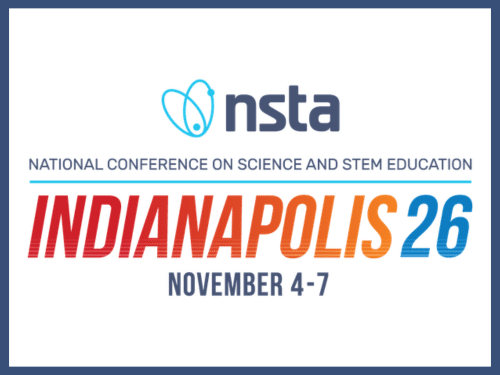
NSTA 2026 Indianapolis
The BSCS Science Learning team is excited to be part of the NSTA National Conference on Science Education in Indianapolis, November 4–7, 2026. This premier professional learning event brings together science educators, leaders, coaches, and curriculum decision-makers for four days of collaboration, learning, and inspiration.
BSCS will offer a range of sessions focused on strengthening science teaching and learning through research-based practices and high-quality instructional materials. Explore three-dimensional, phenomenon-driven science learning; equitable instruction; support for multilingual learners; and effective implementation of high-quality instructional materials. Whether you’re looking to deepen student sensemaking, support meaningful NGSS implementation, or strengthen science teaching across your school or district, we hope you’ll join us in Indianapolis.
Details listed below by clicking each session title, or visit NSTA’s website for updated information, such as location, date, and time.
Wednesday, November 4
Leadership in Motion: Designing the Future of Science Education Leadership +
A joint initiative of NSTA and the National Science Education Leadership Association (NSELA)
FULL-DAY MINI-CONFERENCE
Wednesday, November 4 • 8:15 a.m.–3:45 p.m.
Indiana Convention Center – TBD
General session with breakout sessions. All participants will receive breakfast and lunch.
Join science education leaders from across the nation for a transformative one-day leadership experience focused on strategic vision, systems thinking, collaboration, and building cultures of innovation. Participants will strengthen practical leadership skills while collaborating with peers to shape the future of science education at the local, state, and national levels.
Leadership Experience Cohort Selection
During registration, you will be asked to select from one of three leadership experience cohorts (Emerging, Developing, Experienced) that best describes your current role in science education leadership. Your selection will determine your cohort placement and learning pathway throughout the Leadership Development Academy. Each cohort experiences all sessions, but in a sequence intentionally designed for your level of leadership experience.
BSCS Breakout Session for Each Cohort
Lead Yourself Before Leading Systems
Examine the leadership habits and responses that shape your daily work and team interactions. Strengthen your emotional intelligence and refine your approach to leading through change through real world application. Leave with a personalized leadership profile and a renewed commitment to leading effectively in the moments that matter most.
Because the most effective leaders understand themselves first.
SPEAKERS:
Jenine Cotton-Proby (BSCS Science Learning: Colorado Springs, CO), Cynthia Gay (BSCS Science Learning: Colorado Springs, CO), Jody Bintz (BSCS Science Learning: Colorado Springs, CO)
PLI-3: From the Sky to Your School: Exploring and Implementing OpenSciEd Elementary +
PROFESSIONAL LEARNING INSTITUTE
Wednesday, November 4 • 8 a.m.–3 p.m.
Indiana Convention Center – 135
Conference registration is NOT required to attend. All participants will receive breakfast and lunch.
Have you ever spotted the Moon in the middle of the day, or wondered why some constellations disappear for months at a time? These are the kinds of questions that stop students in their tracks—and they’re exactly what this unit explores. Come experience a unit from the Elementary OpenSciEd curriculum and see how phenomenon-driven science turns everyday sky observations into deep investigations of Earth’s place in the universe.
You’ll see what it looks like when elementary learners do real science: arguing from evidence, revising their thinking, and driving the storyline with their own questions. You’ll also leave with a clear picture of what it looks like to bring OpenSciEd into your school or district—and get introduced to free, high-quality materials designed to support professional learning communities while teachers are actively teaching the curriculum.
Come ready to be curious, think alongside colleagues, and imagine what becomes possible when rigorous materials meet the brilliance of elementary learners.
TAKEAWAYS:
– The OpenSciEd Elementary curriculum units are designed using a storyline approach, providing students with a meaningful experience motivated by their own desire to explain something they don’t understand or to solve a problem their classroom has come to care about.
– Explore ways to make time for science in an elementary schedule and the math and ELA opportunities incorporated into units.
– Leave this session with free, ready-to-use Professional Learning Communities (PLCs) resources built to help teacher teams implement OpenSciEd Elementary materials with confidence.
SPEAKERS:
Dr. Guy Ollison (BSCS Science Learning: Colorado Springs, CO), Tami Plein (STEM Consultant: Burlington, IA)
PLI-6: Supporting Multilingual Learners: Expanding collective sensemaking in science classrooms +
PROFESSIONAL LEARNING INSTITUTE
Wednesday, November 4 • 8 a.m.–3 p.m.
Indiana Convention Center – 137
Conference registration is NOT required to attend. All participants will receive breakfast and lunch.
Every student deserves access to high-quality, meaningful science instruction designed to leverage and support students’ linguistic resources. Join professional learning leaders from BSCS Science Learning and NSTA for a full-day deep dive into classroom instruction that supports multilingual learners through rich, engaging, and inclusive science learning experiences.
In this immersive session, we’ll explore the specific approaches using lesson and unit examples to see how intentional strategies and routines promote language and science understanding. You’ll learn how high-quality science curricula foster opportunities for multilingual learners to interact with the classroom community to share their ideas, deepen their ability to engage in science, and make sense of the natural world.
TAKEAWAYS:
– How intentional instructional design supports multilingual learners
– Strategies that promote language-rich, collaborative science classrooms
– Real-world examples and specific strategies from classrooms
SPEAKERS:
Janna Mahfoud (BSCS Science Learning: Colorado Springs, CO), Dr. Susan Gomez Zwiep (BSCS Science Learning: Colorado Springs, CO)
Thursday, November 5
LI-1: Leading Change That Sticks: Systemic and Sustained Improvement through Curriculum Implementation +
LEADERS INSTITUTE
Thursday, November 5 • 8 a.m.–3 p.m.
Indianapolis Marriott Downtown – Marriott Ballroom 5
National Conference registration is NOT required to attend the Leaders Institute. However, participants who register for the Leaders Institute are eligible to purchase conference registration at a discounted rate. Details will be emailed after you register. All participants will receive breakfast and lunch.
Join science education leaders to collaboratively explore the critical leadership actions needed to drive system-wide change across every stage of curriculum implementation. In this immersive, research-based experience, you’ll engage with proven strategies and practical frameworks while strengthening the leadership mindset required to guide change with confidence—from building the case to sustaining long-term impact. Develop the approaches needed to move your organization forward and create a more adaptive, thriving system.
TAKEAWAYS:
– Deepen understanding of principles of change.
– Increase the ability to lead change as part of a strategy to strengthen science teaching and learning through curriculum implementation.
– Strengthen the ability to deal with reluctant staff (e.g., other leaders, teachers).
SPEAKERS:
Jenine Cotton-Proby (BSCS Science Learning: Colorado Springs, CO), Jody Bintz (BSCS Science Learning: Colorado Springs, CO)
Embedding Literacy Supports in 3D Units for Equitable Sensemaking and Learning +
HANDS-ON WORKSHOP
Thursday, November 5 • 8–9 a.m.
Indiana Convention Center – 234
STRAND: Connecting the Dots: Integrated Learning for Durable Skills
Experience how embedding literacy supports for reading, writing, and academic discourse in 3D teaching and learning promotes sensemaking and science understanding for ALL learners! Learn how the BSCS Anchored Inquiry Learning (AIL) instructional model succeeds the 5Es and embeds literacy supports throughout cycles of inquiry. The NGSS calls for 3D learning grounded in real world phenomena to ensure science learning is equitable and relevant to all students. The SEPs and CCCs require sensemaking of complex texts and data as well as communicating explanations and arguments and engaging in scientific discourse. In this session, participants will 1) experience literacy strategies that support student engagement in the SEPs and CCCs, 2) consider how these strategies support all students, particularly below grade-level readers and EMLs, in sensemaking, and 3) consider how embedding these strategies in assessments allows all students to demonstrate their learning.
TAKEAWAYS:
The research-based BSCS Anchored Inquiry Learning instructional model succeeds the 5Es and embeds literacy supports for reading, writing, and academic discourse in conjunction with science and engineering practices and crosscutting concepts to promote students in figuring out key science ideas.
SPEAKER:
Cynthia Gay (BSCS Science Learning: Colorado Springs, CO)
Enhancing Multilingual Learners’ Language Use for Scientific Sensemaking +
HANDS-ON WORKSHOP
Thursday, November 5 • 8–9 a.m.
Indiana Convention Center – 135
STRAND: High-Quality Science Teaching for Multilingual Learners and All Students
How can we design science learning that allows multilingual learners to shine? This session explores instructional approaches and teacher moves that create rich opportunities for students to use their full range of meaning-making resources. Through classroom examples—such as building consensus ideas or sharing noticings and wonderings about puzzling phenomena—we’ll examine moments when students make their thinking public, collaborate, and grow as sensemakers. Drawing on BSCS Science Learning’s research and curriculum development, this session offers concrete, classroom-tested strategies you can bring back immediately.
TAKEAWAYS:
Multilingual learners are brilliant and capable of engaging in rich and rigorous scientific sensemaking when classrooms make space for their ideas. Walk away with practical tools and routines that elevate student thinking and strengthen whole-class science sensemaking.
SPEAKER:
Dr. Susan Gomez Zwiep (BSCS Science Learning: Colorado Springs, CO)
Participatory Science in Action: FieldScope’s Ready-to-Use Classroom Data Explorations +
HANDS-ON WORKSHOP
Thursday, November 5 • 8–9 a.m.
Indiana Convention Center – 232
STRAND: AI, Data, and Technology Tools for Career-Connected Science
Want to help high school students analyze community and citizen science data? Want to use real data in your classroom to support your existing curriculum? FieldScope and BSCS Science Learning offer “Invitations to Inquiry,” free instructional activities designed to connect learners with real-world environmental data. These free lessons build student confidence in using scientific evidence to answer critical questions about our planet and the natural world. BSCS Science Learning’s Invitations to Inquiry help high school students work with community and citizen science data from projects hosted on FieldScope—BSCS’s platform for collecting, displaying, and analyzing data. Invitations to Inquiry are activities in which students explore FieldScope’s mapping and graphing tools to dig into data in the context of meaningful questions. Each lesson engages students in interpreting graphs and maps to learn about where the data are collected and what they mean.
TAKEAWAYS:
Free, ready to use, and adaptable lessons, datasets, and visualizations for your classroom, using community and citizen science projects! Learn how to use the lessons as is or to build them into your existing curriculum! Teacher guides, slides, handouts, and other instructional resources included!
SPEAKER:
Jamie Deutch Noll (BSCS Science Learning: Colorado Springs, CO)
What 3D Science Learning Looks Like: Building Shared Vision, Observation Skills, and Coaching Moves in OpenSciEd Elementary Classrooms +
HANDS-ON WORKSHOP
Thursday, November 5 • 1–2 p.m.
Indiana Convention Center – 135
STRAND: Supporting Science Educators: Building Capacity, Not Burnout
How do teacher leaders, coaches, and site leaders develop the vision, language, and tools to support teachers making the shifts called for by NGSS? In this session, participants will experience 3-dimensional, phenomenon-driven science instruction through a learner lens using the same high-quality materials their teachers use. Then participants will examine that experience through a coaching lens. We’ll surface the real barriers to implementation that coaches encounter, build a shared set of observation look-fors grounded in firsthand experience, and develop coaching conversation starters tied directly to 3D learning in the classroom. Through this dual lens of learner and coach, participants will leave with a clearer picture of what effective NGSS implementation looks like, sounds like, and feels like and what it takes to support teachers in getting there.
TAKEAWAYS:
Leaders who have been inside the learning coach with more precision. Walk away with observation look-fors and coaching moves built from firsthand experience with OpenSciEd Elementary materials and prepared for your next classroom visit and coaching conversations.
SPEAKER:
Dr. Guy Ollison (BSCS Science Learning: Colorado Springs, CO)
Demystifying Data: Free, NGSS-Aligned BSCS FieldScope Lessons to Enhance Your Existing Curriculum +
HANDS-ON WORKSHOP
Thursday, November 5 • 1–2 p.m.
Indiana Convention Center – 240
STRAND: AI, Data, and Technology Tools for Career-Connected Science
Want to supercharge your curriculum? Discover how to use FieldScope—a free, interactive data platform—to seamlessly enhance and extend High-Quality Instructional Materials (HQIM). While HQIM provides strong foundational science units, FieldScope allows students to take those concepts further by analyzing and mapping real-world environmental data—from tracking local water quality to monitoring global biodiversity—contributed by peers and scientists worldwide.
The NGSS demands that students analyze complex datasets and argue from evidence. FieldScope bridges this gap, acting as a powerful, plug-and-play supplement to your existing curriculum. We will walk through ready-to-use, standard-aligned activities that build critical data literacy and spatial reasoning skills. Bring your own device, roll up your sleeves, and leave with a complete toolkit to bring authentic citizen science to your current HQIM units tomorrow!
TAKEAWAYS:
Want to transform your students from passive observers into active citizen scientists? Join us for a hands-on exploration of FieldScope, a free, powerful interactive platform designed for analyzing environmental data. In this session, you’ll discover how to engage students in real-world investigation.
SPEAKER:
Jamie Deutch Noll (BSCS Science Learning: Colorado Springs, CO)
Math as a Tool for Science Sensemaking in Elementary Classrooms +
PRESENTATION
Thursday, November 5 • 2:20–3:20 p.m.
Indiana Convention Center – 135
STRAND: Connecting the Dots: Integrated Learning for Durable Skills
Discover how mathematics becomes a powerful tool for science sensemaking in elementary classrooms through the lens of OpenSciEd Elementary units. In this session, participants will experience how elementary-age learners engage with mathematics and computational thinking and data—measurements, observations, sketches, photos, and recordings—to make sense of real-world phenomena featured in OpenSciEd investigations. We’ll explore how children notice and describe variability, create visual displays to organize their ideas, and analyze and interpret patterns to answer questions and spark new inquiries. Through an immersive experience grounded in OpenSciEd materials, participants will experience how integrating mathematics, computational thinking, and data science practices into elementary science instruction deepens reasoning, supports a range of learners, and empowers children to think critically about the data they encounter every day.
TAKEAWAYS:
OpenSciEd K-5 units create rich opportunities to use math as a tool for sensemaking by exploring variability, creating data displays, and analyzing and interpreting patterns—strengthening students’ mathematics, computational thinking, and data literacy while supporting grade-level standards.
SPEAKER:
Dr. Guy Ollison (BSCS Science Learning: Colorado Springs, CO)
We Heard You! National Survey Insights on Environmental Science Classrooms, Teacher Wants, and Free FieldScope Data Tools +
PRESENTATION
Thursday, November 5 • 2:20–3:20 p.m.
Indiana Convention Center – 232
STRAND: AI, Data, and Technology Tools for Career-Connected Science
We heard you! What is really happening in high school environmental science classrooms? In this presentation, we reveal groundbreaking national study insights from a partnership between NAAEE, BSCS Science Learning, and The FieldScope Project. Discover what teachers nationwide reported across four core areas: classroom topics, instructional decision-making, data practices, and systemic barriers. Moving from data to solutions, we will preview how these findings are directly driving the development of future high school environmental science units. Discover how these upcoming, free units will be grounded in real teacher needs—not assumptions—to solve instructional overload. Attendees will see how FieldScope’s interactive data tools will anchor these future units with time-saving workflows for real-world data and community science. Join us to uncover these national trends, preview the future of environmental curriculum, and leave with a digital toolkit of current resources.
TAKEAWAYS:
Attendees will analyze NAAEE/BSCS national survey insights to understand environmental science classroom trends and see how this data will inform the design of future, free FieldScope units tailored to real teacher and student needs.
SPEAKER:
Jamie Deutch Noll (BSCS Science Learning: Colorado Springs, CO)
Using Societal Challenges as Phenomena in 3D Units to Develop Student Agency +
HANDS-ON WORKSHOP
Thursday, November 5 • 3:40–4:40 p.m.
Indiana Convention Center – 231
STRAND: Three-Dimensional Teaching, Curriculum, and Assessment
Experience how leveraging complex culturally relevant societal challenges as phenomena in 3D teaching and learning supports student motivation and engagement and develops student agency within and beyond the classroom! The Framework for K-12 Science Education and NGSS call for learning grounded in real world phenomena and problems to ensure that science learning is relevant to all students. The AIL instructional model succeeds the 5Es and utilizes complex and culturally relevant societal challenges to anchor multiple cycles of inquiry and sensemaking, culminating with student explanations/design solutions. AIL employs science education research emphasizing coherence from students’ perspective. In this session, participants will 1) consider their own ideas about teaching complex societal challenges, 2) experience 3D learning, and 3) consider the science concepts of a societal challenge (antibiotic resistance, heart disease, food sustainability, anthropogenic changes to biodiversity).
TAKEAWAYS:
The research-based BSCS Anchored Inquiry Learning instructional model succeeds the 5Es and leverages complex societal issues as anchoring phenomena/problems, culminating tasks, and performance assessments in 3D units of instruction to motivate students and develop agency in addressing these issues.
SPEAKER:
Cynthia Gay (BSCS Science Learning: Colorado Springs, CO)
Read It, Write It, Investigate It! Integrating Science and Literacy to Enhance Learning +
PRESENTATION
Thursday, November 5 • 3:40–4:40 p.m.
Indiana Convention Center – 135
STRAND: Connecting the Dots: Integrated Learning for Durable Skills
How do literacy and science practices strengthen one another, and what can that look like in elementary classrooms? In this session, participants will learn about key research-based principles for integrating literacy and science in elementary classrooms. We will also engage with K-5 materials from the OpenSciEd Elementary curriculum as a model for how to enact these principles in classrooms. This will include a review of student-facing materials, including a variety of grade-level science texts, to showcase how integrating literacy practices into science lessons enhances both science and literacy learning. We will also examine teacher-facing materials and other curricular resources to understand how these tools help make the connections between science and ELA explicit. Finally, the presentation will highlight how teachers can apply these key principles in their classrooms to support young children’s sensemaking and ELA development.
TAKEAWAYS:
Integrating literacy practices within elementary science strengthens learning in both science and ELA. Participants will learn key research-based principles for integrating literacy into science time to support students’ sensemaking in science, while also building their ELA skills.
SPEAKER:
Dr. Susan Gomez Zwiep (BSCS Science Learning: Colorado Springs, CO)
Friday, November 6
Leading Change That Sticks: Furthering NGSS implementation using High Quality Instructional Materials +
HANDS-ON WORKSHOP
Friday, November 6 • 9:20–10:20 a.m.
Indiana Convention Center – 135
STRAND: Three-Dimensional Teaching, Curriculum, and Assessment
Join BSCS as we share and discuss how leadership can support NGSS implementation through planning for professional learning experiences that center the needs of teachers and students through the use of high quality instructional materials. We will discuss how leaders can leverage high quality instructional materials to strengthen the shared vision of the instructional shifts called for by the NGSS. Hear how a state level partnership with multiple LEAs deepened teacher’s knowledge of the NGSS and three dimensional instructional practices.
TAKEAWAYS:
Using high quality instructional materials as a lever to further NGSS implementation across multiple district/school contexts can support teachers and leaders as they enhance and expand their practice to improve outcomes for their students and learning communities.
SPEAKERS:
Dr. Guy Ollison (BSCS Science Learning: Colorado Springs, CO), Jenine Cotton-Proby (BSCS Science Learning: Colorado Springs, CO)
Science in Every Voice: Teaching for Cultural and Linguistic Sensemaking +
PRESENTATION
Friday, November 6 • 9:20–10:20 a.m.
Indiana Convention Center – 137
STRAND: High-Quality Science Teaching for Multilingual Learners and All Students
What does it mean to create science classrooms where every student’s way of making sense—through language, questions, and shared ideas—is treated as rigorous scientific thinking? In this session, participants will explore how linguistic sensemaking creates more meaningful and equitable opportunities for students to engage in science. Using classroom examples and instructional routines from BSCS Science Learning’s work with teachers and students, we will examine how students’ language practices—such as sharing noticings, asking questions, and building ideas together—can be intentionally leveraged to support phenomenon-based science learning. Participants will reflect on their own instructional choices and consider practical moves that help all students use language to make their thinking visible and see themselves as capable contributors to scientific understanding.
TAKEAWAYS:
Participants will leave with concrete approaches for designing and facilitating science instruction that values students’ cultural and linguistic assets, strengthens engagement, and supports equitable participation in classroom sensemaking.
SPEAKER:
Dr. Susan Gomez Zwiep (BSCS Science Learning: Colorado Springs, CO)
Coaching to Elevate and Expand Language During Science Instruction +
PRESENTATION
Friday, November 6 • 10:40–11:40 a.m.
Indiana Convention Center – 137
STRAND: High-Quality Science Teaching for Multilingual Learners and All Students
Instructional coaches, teacher leaders, and teaching teams often ask the question, “How can we better support multilingual students during science?” We have lists and websites and books of MLL strategies, but how can we intentionally (and swiftly) make decisions that work with and support high quality science instruction? Join BSCS Science Learning to consider ways instructional leaders can support educators and teaching teams as they seek to better support multilingual learners while using adopted science instructional materials.
TAKEAWAYS:
Sometimes MLL supports can feel at odds with collaborative, inquiry-based science learning. By focusing on how to elevate and expand the language students use during discourse-rich, science sensemaking, MLL supports can enhance rather than detract from instruction where students figure out together.
SPEAKER:
Janna Mahfoud (BSCS Science Learning: Colorado Springs, CO)
Leading Change That Sticks: Managing Conflict +
HANDS-ON WORKSHOP
Friday, November 6 • 10:40 a.m.–12:10 p.m.
Indiana Convention Center – 135
STRAND: Supporting Science Educators: Building Capacity, Not Burnout
Enacting the NGSS using high-quality instructional materials requires support as teachers take on the corresponding shifts in practice, potentially significant shifts. Sometimes when leading this kind of significant change, you get more than resistance–you get conflict. Dig into Change Management as one critical element curriculum based professional learning to help manage conflict. Whether connecting with us anew or continuing your learning from the Leaders Institute, join BSCS Science Learning to: consider your experiences with leading change, encountering resistance, and managing conflict alongside other leaders; consider different sources of conflict and strategies for managing conflict; and practice one strategy for managing yourself during conflict.
TAKEAWAYS:
Learn to identify different sources of conflict, consider strategies for managing conflict, and practice a key strategy to manage yourself during conflict.
SPEAKERS:
Jenine Cotton-Proby (BSCS Science Learning: Colorado Springs, CO), Jody Bintz (BSCS Science Learning: Colorado Springs, CO)
Leading Change That Sticks: Using Data to Inform Next Steps +
PRESENTATION
Friday, November 6 • 1:20–2:20 p.m.
Indiana Convention Center – 135
STRAND: Three-Dimensional Teaching, Curriculum, and Assessment
Collecting and analyzing data to inform decision-making is an important step in sustaining broad and effective implementation of HQIM and the practices likely to improve each student’s learning. Join BSCS to dig into one district’s efforts to enact and monitor a curriculum implementation plan.
TAKEAWAYS:
One important step in sustainability of teacher and leader practices that are likely to improve the learning of each student is to collect and analyze implementation data to inform decision-making.
SPEAKERS:
Jenine Cotton-Proby (BSCS Science Learning: Colorado Springs, CO), Jody Bintz (BSCS Science Learning: Colorado Springs, CO)
Developing and Using Models: Supporting Equitable Sensemaking and Assessment +
HANDS-ON WORKSHOP
Friday, November 6 • 4–5 p.m.
Indianapolis Marriott Downtown – Marriott Ballroom 7
STRAND: Three-Dimensional Teaching, Curriculum, and Assessment
Experience how developing and using models in 3D teaching and learning promotes sensemaking and science understanding for ALL learners! Explore ways to support students in this key science and engineering practice! The Framework for K-12 Science Education and NGSS call for learning grounded in real world phenomena and problems to ensure that science learning is relevant to all students. The AIL instructional model succeeds the 5Es and leverages the SEP of developing and using models as a sensemaking strategy, creating a safe and equitable culture that makes student thinking visible and encourages academic discourse and revising ideas. In this session, participants will 1) explore the importance of modeling in 3D teaching, learning, and assessment 2) experience strategies that support student confidence in modeling, and 3) consider how modeling supports all students, particularly below grade-level readers and EMLs, in sensemaking.
TAKEAWAYS:
The research-based BSCS Anchored Inquiry Learning instructional model succeeds the 5Es and leverages developing and using models as a key science and engineering practice to create an equitable culture of academic discourse, making thinking visible, sensemaking, and revising ideas.
SPEAKER:
Cynthia Gay (BSCS Science Learning: Colorado Springs, CO)
Saturday, November 7
Exploring Nuclear Energy and Radiation through Jigsaws and Card Sorts +
HANDS-ON WORKSHOP
Saturday, November 7 • 10:20–11:20 a.m.
Indiana Convention Center – 207
STRAND: Three-Dimensional Teaching, Curriculum, and Assessment
Jigsaws and card sorts can be a three-dimensional way for students to learn a great deal of information. Working in groups, attendees will put on their student hat and engage in scientific discourse as they obtain, evaluate, and communicate scientific information (SEP 8). NGSS PE HS-PS1-8 focuses on the energy released during the processes of fission, fusion, and radioactive decay. As we learn about these forms of energy release, questions of safety emerge. Based on the events of the three largest nuclear reactor accidents, learners will jigsaw to understand how energy can be harnessed but also how quickly things can go amiss. After reviewing alpha, beta, and gamma radiation in each scenario, we will use a card sort to consider that not all radiation is necessarily bad—scale, proportion, and quantity determine impact (CCC 3). As we attempt to place information cards into different categories, learners grapple with the range from unquestionably harmful to lifesaving.
TAKEAWAYS:
Jigsaws and card sorts can be an effective way to engage students with vetted science information while fostering sensemaking and communication. This session draws on the events of the three largest nuclear reactor accidents to explore fission and radioactivity.
SPEAKERS:
Maree Funk (SSP International: Wilmington, DE), Dan Voss (BSCS Science Learning: Colorado Springs, CO), Dr. Julie Bokor (SSP International: Wilmington, DE)